
In many parts of the world power is a constraint that needs to be taken very seriously. Power is not all equal around the world, some have more than others. When building your FEC entertainment facility, depending on state laws, councils, governmental laws and even the cost of power, electricity can be extremely expensive.
When building your Delta Matrix interactive LED Floor game facility, you want to make sure that you understand all of the costs involved, including how much power the floor will use and what that could potentially cost you over the year.
In this blog, we will go over how much power the Delta Matrix LED floors use and what that could potentially cost your facility.
How Much Power Does Each LED Tile Use?
We recently measured the power consumption directly from a wall outlet to get a better understanding of the real-world power requirements of the Delta Matrix LED Floor.
During the test, the rainbow idle animation used approximately 3.4 watts per tile.
It is important to understand that this is an idle animation and not necessarily what the floor will use during normal gameplay. Games generally use less power because many of the tiles are not illuminated at the same time.
However, when designing the power supplies and circuitry, we need to account for the worst-case scenario.
The maximum measured/design scenario is approximately 7.2 watts per tile when all of the LEDs are displaying white.
This gives us two important numbers:
- 3.4W per tile — Rainbow idle animation
- 7.2W per tile — Worst-case scenario with all tiles displaying white
The 7.2W figure is particularly important when planning the electrical infrastructure because the power system needs to be capable of handling the maximum possible load.
Example: DELTA STRIKE VENUE OPERATOR
Let's take a real example.
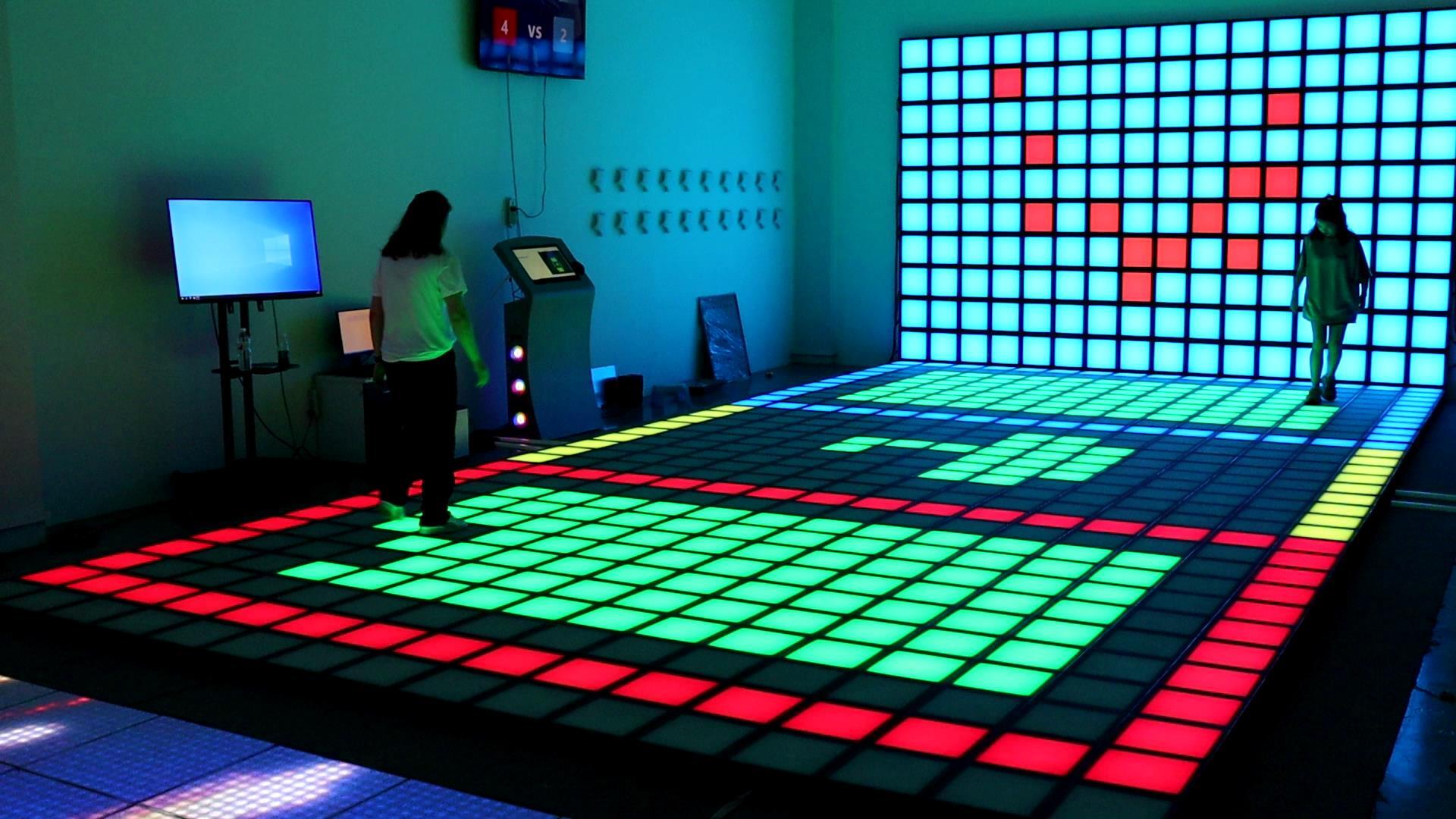
The Laser Strike floor is 16 x 20 tiles, with an additional 16 x 6 wall.
This gives a total of:
16 x 26 = 416 tiles
So the entire installation contains 416 LED tiles.
If we use the 3.4W idle-animation figure, the floor would consume approximately:
416 x 3.4W = 1,414.4W
That is approximately 1.41kW while running the rainbow idle animation.
If the floor were operating for 12 hours every day, we can calculate the yearly power consumption:
1.4144kW x 12 hours x 365 days = approximately 6,196kWh per year
At an electricity cost of $0.30 per kWh, that would be approximately:
6,196 x $0.30 = $1,859 per year
This is an estimate based on running the entire 416-tile installation continuously for 12 hours per day at the 3.4W-per-tile idle animation power consumption.
What About Worst Case Power?
Now let's look at the maximum scenario.
At 7.2W per tile:
416 x 7.2W = 2,995.2W
So the full installation could require approximately 3.0kW when every tile is displaying full white.
If this maximum load was somehow maintained for 12 hours every day:
2.9952kW x 12 x 365 = approximately 13,118kWh per year
At $0.30 per kWh:
13,118 x $0.30 = approximately $3,935 per year
However, this is a worst-case calculation, not a typical operating cost.
It would be unusual for an interactive game floor to operate with every LED on full white continuously for 12 hours a day. Games are constantly changing what is displayed, and many tiles may be off or running at lower brightness.
Why Is Understanding Power Important?
When building an FEC, power consumption is something that should be considered early in the design process.
It is not just about the cost of the electricity. You also need to consider the electrical infrastructure required to support the equipment.
Depending on where your facility is located, you may need to consider:
- Available electrical capacity
- Local electrical codes
- Council or governmental requirements
- Electrical installation costs
- Power distribution
- Circuit and breaker requirements
- HVAC and cooling requirements
- The cost of electricity in your location
- The number of hours the attraction will operate each day
The good news is that the Delta Matrix LED Floor has been designed with these requirements in mind. The power supplies and circuitry are designed around the worst-case power requirements, while normal gameplay can use considerably less power.
Putting It Into Perspective
For the 416-tile installation, the difference between the idle rainbow animation and the absolute worst-case full-white scenario is significant.
At the idle animation level, the installation is around 1.41kW.
At the maximum full-white level, it is around 3.0kW.
This means that when planning your facility, you should design the electrical system around the maximum possible load, while understanding that the actual day-to-day energy consumption will generally be lower.
Power is an important part of building any modern FEC attraction. Understanding the numbers before construction can help you plan your electrical requirements, estimate operating costs and avoid surprises once the facility is open.
The Delta Matrix LED Floor gives operators an interactive attraction while keeping power consumption something that can be measured, planned for and understood before you build.
FAQ
1. How much power does a Delta Matrix LED tile use?
A Delta Matrix LED tile uses approximately 3.4 watts per tile when running the rainbow idle animation. During normal gameplay, the power consumption can be lower because many tiles may be off or not fully illuminated.
2. What is the maximum power consumption?
The worst-case scenario is approximately 7.2 watts per tile when all tiles are displaying full white. The power supplies and circuitry are designed to handle this maximum load.
3. How much power does a 416-tile installation use?
A 416-tile installation would use approximately 1.41kW at 3.4W per tile during the rainbow idle animation.
At the maximum 7.2W per tile, the installation could require approximately 3.0kW.
4. How much does it cost to run the LED floor?
The cost depends on your local electricity rate and operating hours. As an example, if electricity costs $0.30 per kWh and a 416-tile installation runs for 12 hours every day at the 3.4W idle-animation level, the estimated electricity cost would be approximately $1,859 per year.
Actual costs will vary depending on gameplay, brightness, operating hours and local electricity prices.